
Renovation
How Much Does a Home Renovation Cost in Edinburgh? A 2026 Budget Guide
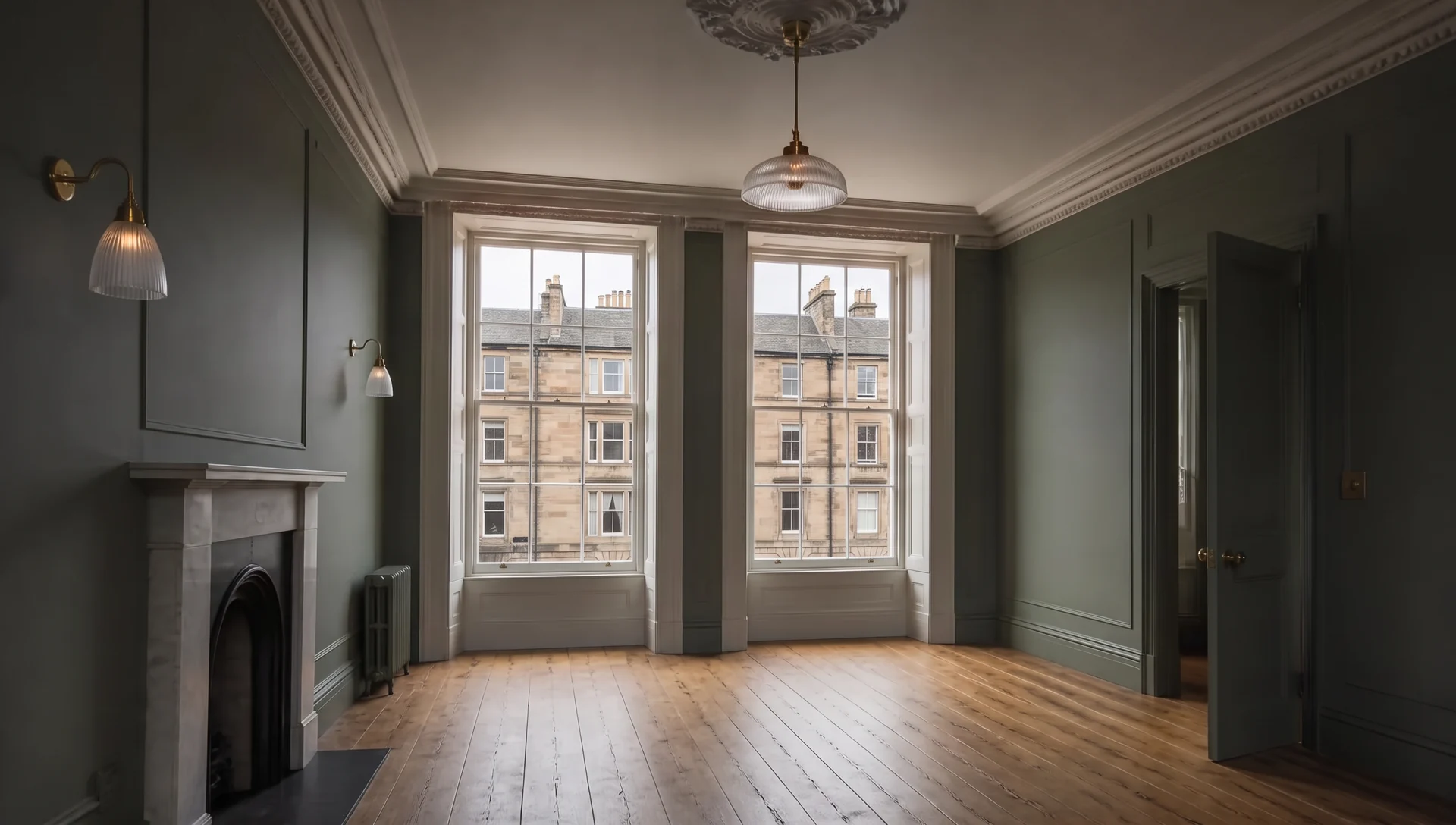
Tenement renovation in Edinburgh
See the scope we price, the programme we work to and the documentation you receive at hand-over.
View the serviceWe deliver this work as tenement renovation in edinburgh and kitchen fitting across Edinburgh, across Edinburgh and the Lothians. If your property is in Stockbridge, that page sets out the housing stock, consents and access issues we plan around there.
The first question almost every owner asks is the hardest one to answer honestly: what will this cost? Renovation quotes in Edinburgh vary wildly, not because contractors disagree on labour rates, but because they are usually pricing different scopes without saying so.
This guide sets out where the money actually goes on an Edinburgh renovation in 2026, which items are fixed, which are elastic, and how to build a budget that survives contact with a pre-1919 building.
The three cost tiers
Most Edinburgh projects fall into one of three tiers. A refresh keeps the layout and services and replaces finishes: decoration, flooring, doors and ironmongery. A full refurbishment replaces services and finishes throughout, usually including a new kitchen and bathroom. A structural renovation moves walls, forms new rooms, alters drainage or opens up roof space.
The tier, not the floor area, is the single biggest driver of cost. A large flat given a refresh can cost less than a small flat taken back to bare stone, so agree the tier before comparing any two numbers.
What the cost actually covers
Before comparing any figures, it helps to see the whole list of works a renovation budget has to absorb. On a full refurbishment of an Edinburgh flat, the scope usually breaks down like this:
Strip out, structural alterations and making good. Electrics, plumbing, heating and certification. Plaster, levelling and joinery repairs. Kitchen and bathroom supply and installation. Flooring, decoration and finishes. Then the items owners forget: skip hire and waste removal, protection of the common stair, professional fees and consents, and a contingency for what appears behind the plaster.
A quote that omits any of those lines is not cheaper, it is simply less complete. Ask for the list, line by line, before you compare two numbers.
Published rate ranges, for orientation only
The ranges below are drawn from published UK cost guides, principally Checkatrade's 2026 renovation and trade cost breakdowns, so you have an independent yardstick rather than our own numbers. They are national guide figures for orientation while you plan. They are not a PCS Scot Ltd quotation, we are not bound by them, and Edinburgh tenement work commonly sits at the upper end because of access, stone, and period construction.
Whole-property renovation: published UK guides put a full house renovation broadly between £60,000 and £180,000 depending on size, condition and specification, with higher end or larger period properties running beyond that.
Rewiring: Checkatrade's guide ranges from around £3,900 for a one-bedroom flat up to around £10,000 for a five-bedroom house, including certification.
Room and element work: bathrooms, kitchens, plastering and window repair each move across a wide band depending on specification rather than floor area. A fitted kitchen in particular can double on cabinetry and worktop choice alone without adding a single labour day.
Treat all of the above as a sense check, not a price. The only number that means anything for your property is one priced against a measured survey and a written scope.
Where the money goes
On a full refurbishment, the trades that cannot be value-engineered are the ones you never see: electrical rewiring and certification, plumbing and heating, plastering and levelling, and making good after strip-out. Together those routinely account for around half of a project budget.
The visible items, kitchen, bathroom, flooring, joinery and decoration, are where specification moves the number. Cabinetry construction, worktop material and sanitaryware are elastic across a wide range, which is why we quote them as clear tiers rather than a single figure.
Access, waste removal and protection of common stairs are real costs in tenement work and are often missing from cheaper quotes. So is scaffolding where external stone, roof or window work is involved.
Period property premiums
Pre-1919 buildings carry costs a new-build never will. Lath and plaster ceilings often need overboarding or replacement. Floors are rarely level, so cabinetry and tiling need scribing rather than dropping into place. Sash and case windows need repair, draught-proofing and sometimes full section replacement by a joiner.
Conservation area and listed building status can add consent timescales and specification constraints, particularly for windows, external doors and anything visible from the street. None of this is unpredictable, but it has to be surveyed before it can be priced.
How to build a budget that holds
Start with a measured survey and a written scope, then price that scope once. A budget built from a mood board will move; a budget built from a scope will not.
Hold a contingency of ten to fifteen per cent on any period property. It is not padding, it is the allowance for what appears when floors come up and walls come off, and on a well-surveyed job most of it comes back unspent.
Fix your specification before ordering anything with a lead time. Late changes to kitchens, stone worktops and sanitaryware are the most common cause of both overspend and delay.
What a credible quote looks like
A credible Edinburgh renovation quote names the scope line by line, states what is excluded, shows the programme in stages, and identifies who holds responsibility for certification at hand-over. Anything that arrives as a single figure with no breakdown cannot be compared with anything else.
You should also expect a documented hand-over: electrical certification, gas and appliance registrations, product warranties, and a record of what was installed where. That paperwork is what turns spend into a defensible asset value.
If you want your own project costed against a written scope rather than a guess, send us the property and the outcome you want through the project brief, or email enquiries@pcs-scot.uk. We survey, price the scope once, and set out the programme before any work is committed.
What the finished result should look like
The point of a controlled budget is not the saving, it is the finish. A properly delivered Edinburgh renovation reads as original: cornice repaired rather than replaced, sash and case windows working and draught-proofed, floors levelled before boarding, joinery scribed to the room rather than dropped in, and services concealed and certificated.
That standard is what we hold ourselves to on every project, and it is why we price a written scope once instead of quoting a headline figure and revising it later.
Cost guides by type of work
Each guide below sets out what actually moves the number on that type of work in Edinburgh, what our quote covers, and what to establish before you ask anyone to price it.
Bathroom renovation cost in Edinburgh
Drainage position, floor condition, tanking extent and specification: what moves a bathroom number.
Read the guideKitchen renovation cost in Edinburgh
Cabinetry build, worktop material, service alteration and room geometry: the four levers on a kitchen.
Read the guideTenement renovation cost in Edinburgh
Condition, consents, services replacement and common stair access set a tenement number.
Read the guideVoid refurbishment cost in Edinburgh
Check-out condition, compliance gaps, turnaround window and durability of specification.
Read the guideBespoke joinery cost in Edinburgh
Material, construction, survey accuracy and site scribing, rather than a rate per metre.
Read the guideFrequently asked questions
How much does it cost to renovate a flat in Edinburgh?+
Cost is set by the tier of work rather than floor area. A finishes-only refresh, a full refurbishment with new services, kitchen and bathroom, and a structural renovation that alters layout or drainage sit at very different levels. Establish the tier and the written scope first, then price that scope once, so competing quotes are actually comparable.
What contingency should I allow on a period property?+
Allow ten to fifteen per cent on any pre-1919 building. Once floors are lifted and finishes removed, perished wiring, failed plumbing, rot in window cills and unlevel structure are all common findings. A proper condition survey reduces the surprises, and on a well-surveyed job most of the contingency is returned unspent.
Which parts of a renovation budget are fixed?+
Rewiring and certification, plumbing and heating, plastering and levelling, strip-out and making good, and access and waste handling are effectively fixed by the building and the regulations. Kitchens, bathrooms, flooring, joinery and decoration are elastic, which is where specification tiers let you control the total without cutting into the work you cannot see.
Do renovation costs include VAT and professional fees?+
Ask explicitly, because that is where two quotes most often diverge. Our pricing states what is included, what is excluded, and where fees, consents or surveys sit, so there is no ambiguity at invoice stage.